Europe's radar eyes are renewed, and the six day cycle is back
Sentinel-1 is the first Copernicus constellation to complete its renewal
What happens when the satellite that has been watching Europe's ground move, millimetre by millimetre, for twelve years is finally switched off?
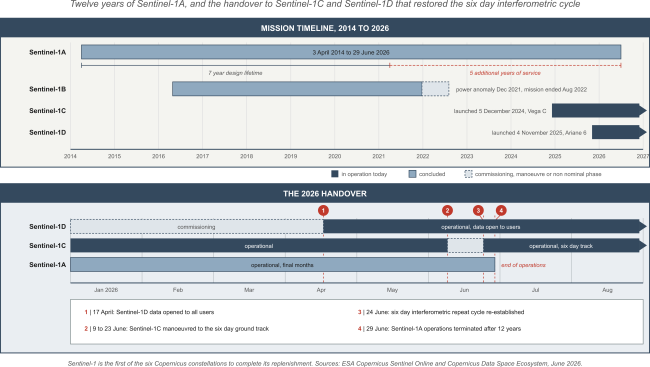
In June 2026 the Copernicus Sentinel-1 mission quietly passed one of the most important milestones in its history. On June 24th, the constellation re-established its nominal six day interferometric repeat cycle, now carried by the two newest units, Sentinel-1C and Sentinel-1D. Five days later, on June 29th, the European Space Operations Centre (ESOC) confirmed the end of operations of Sentinel-1A, the very first Copernicus satellite, launched on April 3, 2014 with a design lifetime of seven years and retired after more than twelve years in orbit.
Sentinel-1 is therefore the first of the six Copernicus constellations to complete its replenishment with brand new “eyes” in space. The handover was deliberately gradual as Sentinel-1D, launched on 4 November 2025 on Ariane 6, opened its data to users on 17 April 2026 and flew for two months alongside Sentinel-1A and Sentinel-1C, so that operational pipelines could absorb the new platform before the old one was withdrawn.
Some legacy numbers in the Sentinel-1 lifespan that matter
- 12-years of operations for Sentinel-1A, against a 7-year design lifetime.
- 6-day interferometric repeat cycle restored on June 24, 2026, with Sentinel-1C and Sentinel-1D flying in the same orbit 180 degrees apart.
- About 1-day revisit over most of Europe, and less at high latitudes, with the two satellite configuration.
- First of 6 Copernicus constellations to complete its renewal.
Why six days, and not twelve, changes the work conducted thusfar
For anyone producing maps of ground movement, the repeat cycle is not a mere detail of the timetable, it is the physics of the measurement. Interferometric SAR compares the phase of two radar acquisitions from nearly the same point in space, and the comparison only works while the ground scatterers stay stable between the two passes. Over rock, bare soil and built-up areas that stability lasts a long time. Over vegetated land, irrigated fields, dunes and wetlands it collapses within days. Halving the temporal baseline from twelve to six days therefore does not simply give twice as many images, it keeps interferometric coherence reliable over surfaces where a twelve-day pair may already be noisy, and it doubles the number of usable pairs in a stack. This improves the precision of a deformation velocity roughly with the square root of that number.
There is a second more important aspect, which is maybe given less attention. Sentinel-1C and Sentinel-1D support the full observation scenario without the reductions that the ageing Sentinel-1A had to accept during eclipse seasons, so the acquisition plan is now more uniform through the year. Both satellites also carry an Automatic Identification System (AIS) payload for ship detection and Galileo enabled receivers for more accurate orbit determination, which directly benefits the geometric quality of the products. This is a significant upgrade relative to Sentinel-1A/B which relied exclusively on a GPS-only 8-channel, dual-frequency GPS receiver, while the addition of Galileo will offer a significant increase in tracked satellites and hence better geometry.
A practical note on continuity
A platform change is never to be used without great care, to construct a long time series. Anyone maintaining multi-year deformation or coherence archives should verify how their processing chain handles acquisitions that span the Sentinel-1A to Sentinel-1C and Sentinel-1D transition, check relative orbit and track continuity, and treat the June 2026 boundary as a candidate discontinuity until it has been tested rather than assumed away. The Sentinel-1A archive itself remains fully available, and it stays the reference for everything observed between 2014 and 2026.
The geospatial dimension
Sentinel-1 is the backbone of every service we build on radar data: flood extent mapping regardless of cloud cover, coastal erosion and shoreline monitoring, subsidence over deltas, ports and infrastructure, soil moisture, and maritime surveillance. A 6-day cycle guaranteed for the coming decade turns several of these from occasional studies into real operational monitoring.
At Consortis Geospatial we follow the evolution of the Copernicus space segment closely, because the design of a monitoring service starts with an honest answer to a simple question: how often, and how reliably, can we actually observe.
Figure 1: The Sentinel-1 relay, 2014 to 2026.
Sources: ESA Copernicus Sentinel Online, Copernicus Data Space Ecosystem and the European Commission DG DEFIS, June and July 2026.
#GeoNews #ConsortisGeospatial #Copernicus #Sentinel1 #SAR #InSAR #EarthObservation #GIS
Bibliography [Accessed 5 August 2026].
- Arianespace (4 November 2025). With Ariane 6, Arianespace successfully launches Copernicus Sentinel-1D satellite. https://newsroom.arianespace.com/?p=47240.
- Copernicus Data Space Ecosystem (24 June 2026). Sentinel-1C/1D Final Orbital Configuration Achieved.https://dataspace.copernicus.eu/news/2026-6-24-s1cd-final-orbital-configuration-achieved Mirror: https://sentinels.copernicus.eu/-/sentinel-1c/1d-final-orbital-configuration-achieved.
- Copernicus Data Space Ecosystem (30 June 2026). Copernicus Sentinel-1A Satellite End of Operations After 12 Years of Service. https://dataspace.copernicus.eu/news/2026-6-30-copernicus-sentinel-1a-satellite-end-operations-after-12-years-service.
- Copernicus Data Space Ecosystem (2 April 2026). Sentinel-1D user data opening and future plans. https://dataspace.copernicus.eu/news/2026-4-2-sentinel-1d-user-data-opening-and-future-plans.
- Copernicus Data Space Ecosystem / Sentinel Online (28 May 2026). Sentinel-1 orbital reconfiguration dates. https://dataspace.copernicus.eu/news/2026-5-28-sentinel-1-orbital-reconfiguration-dates.
- ESA (4 November 2025). Sentinel-1D is launched on Ariane 6. https://www.esa.int/ESA_Multimedia/Videos/2025/11/Sentinel-1D_is_launched_on_Ariane_6.
- European Commission, DG Defence Industry and Space (30 June 2026). Sentinel-1A concludes its mission, leaving a lasting legacy for Copernicus. https://defence-industry-space.ec.europa.eu/sentinel-1a-concludes-its-mission-leaving-lasting-legacy-copernicus-2026-06-30_en.
- EUSPA / European Commission (6 October 2025). Countdown to launch: Copernicus Sentinel-1D lifts off in November. https://eu-space.europa.eu/news/observer-countdown-launch-copernicus-sentinel-1d-lifts-november.
- Ferretti, A., Prati, C., and Rocca, F. (2001). Permanent scatterers in SAR interferometry. IEEE Transactions on Geoscience and Remote Sensing, 39(1), 8 to 20. https://doi.org/10.1109/36.898661.
- Berardino, P., Fornaro, G., Lanari, R., and Sansosti, E. (2002). A new algorithm for surface deformation monitoring based on small baseline differential SAR interferograms. IEEE Transactions on Geoscience and Remote Sensing, 40(11), 2375 to 2383. https://doi.org/10.1109/TGRS.2002.803792.
- Hanssen, R. F. (2001). Radar interferometry: Data interpretation and error analysis (Remote Sensing and Digital Image Processing, Vol. 2). Kluwer Academic Publishers. https://doi.org/10.1007/0-306-47633-9