MAPtheYA
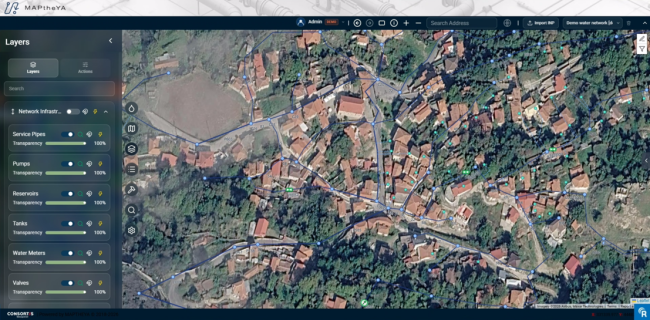
Advanced information system tailored for Water Supply companies, offering comprehensive management and supervision of networks to optimize performance and reduce operational costs.
Architecture of the User Experience
4 pillars
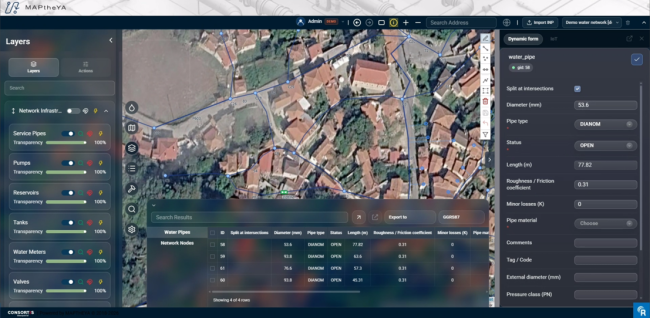
1. Edit: Build and maintain the network geometry and attributes
a. Draw and edit pipes, junctions, valves and tanks directly on the map
b. Automatic snapping to existing pipes keeps the network topologically correct
c. Guided attribute forms with mandatory fields, validation and dropdown look-ups
d. On save, pipe length and start and end junctions are calculated automatically
e. Reshape a pipe and every connected accessory follows the new geometry; move a junction and its segments move with it — data and topology stay intact
f. Multi-user editing lets different teams build out the same network at once
2. Model: Run EPANET-driven hydraulic simulations and scenarios
a. The EPANET solver runs right in the browser — nothing to install
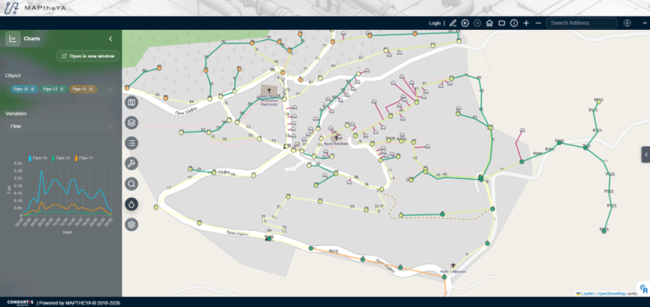
b. Define your modelling parameters, run the simulation and watch flows, pressures and tank levels come to life
c. The network you draw is the model — no separate export step
d. Replay an animated, hour-by-hour view of the network across the full day
e. Define and edit demand patterns and curves
f. Run what-if scenarios: valve closures, pipe failures and pressure-zone changes
g. Chart velocity, pressure and other parameters for individual pipes or junctions and compare them side by side
h. Stored, replayable results support both daily operations and long-term planning
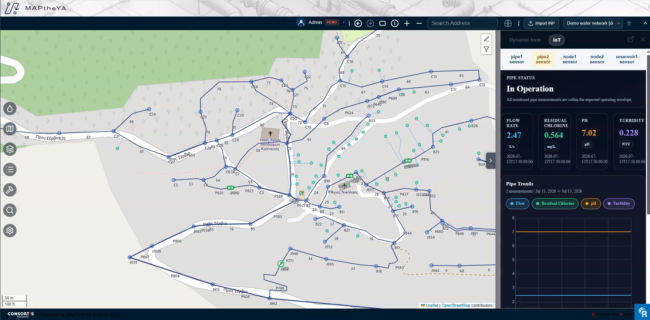
3. Monitor: Track the live network from IoT sensors and hydrometric stations
a. Connect to IoT sensors and hydrometric stations through APIs and view live readings as their own map layers
b. Bring in live external data too — including real-time wind from NOAA — without leaving the map
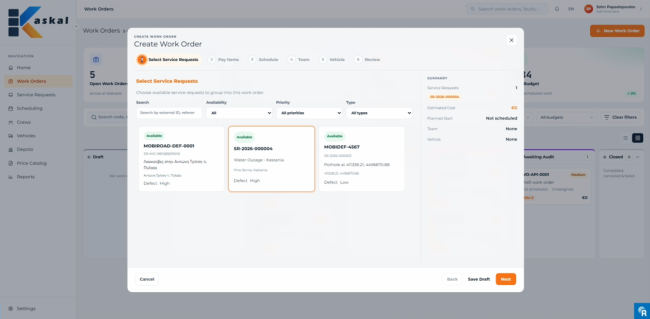
4. Operate: Turn faults and alerts into scheduled, crewed work
a. Faults reported by phone, email or the utility portal appear directly on the network via our APIs
b. Turn any fault into a work order with Kaskal, our crew and work-management app: pick the defects, add pay items, schedule the job, assign the crew and notify every stakeholder using a simple wizard.
What It Offers
- Lower network management and maintenance costs
- Faster response to faults and leaks, from report to repair
- Strategic planning grounded in real-world data
- Better citizen services and greater operational transparency
Key Features
- Unified Mapping: View, manage, and process internal and external water supply and drainage networks through a unified mapping interface
- Topological Rules: Incorporate topological rules to ensure correct hydraulic connectivity and data integrity within the network
- Integration Capabilities: Seamlessly integrate with external systems (e.g., SCADA, CMS, ERP) using REST APIs for enhanced interoperability
- Consumer Data Registration: Record and manage data related to water supply consumers for effective customer service
- Role-Based User Access: Implement user access controls with roles and permissions defined by the system administrator
- Geometric Network Management: Manage the water supply network as a geometric network, utilizing emergency response tools for quick resolution of issues such as defects, leaks, and emergencies
An effective, flexible, and responsive team that offered solutions and stelar expertise.