Geobits Ν°4 : GeoAI: Artificial Intelligence in Geospatial Technology Enters a New Era of Maturity
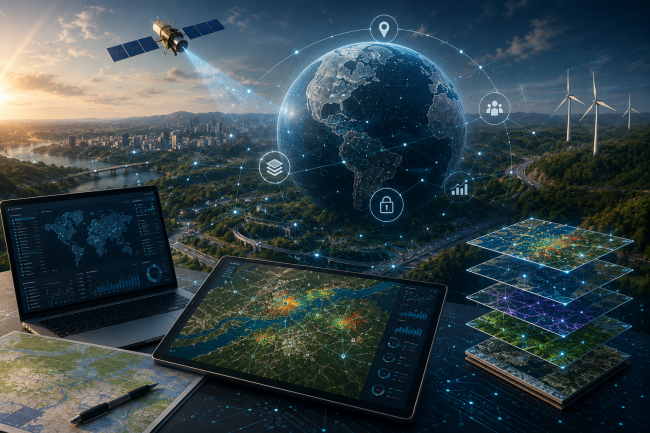
Artificial intelligence is playing an increasingly important role in applications involving maps, location intelligence, infrastructure, and satellite imagery. However, as Bill Dollins highlights in his article, "Geospatial AI State of Play, April–May 2026," the key question is no longer whether GeoAI can deliver valuable results—it is what it takes for us to trust those results.
The first major challenge is accuracy. AI systems can still make mistakes when answering seemingly straightforward geographic questions or fail to identify real-world locations correctly. When AI is used to support spatial decision-making, human expertise, validation, and proper documentation remain indispensable.
A second critical issue is governance and accountability. Governments, public agencies, and professional organizations are increasingly calling for robust regulatory frameworks, greater transparency, and comprehensive documentation for AI systems that influence critical sectors such as infrastructure, land management, public safety, and emergency response.
Another important consideration is the protection of geospatial data. Location data can reveal sensitive information about individuals, communities, and organizations. As a result, the conversation is shifting from "How powerful is the AI model?" to "Who owns the data, who controls it, and how is it being used?"
Finally, the article underscores that AI can generate code, analyses, or maps that appear convincing without necessarily being accurate or reliable. In the geospatial domain, visual appeal alone is not enough. Reliable outcomes require rigorous validation, domain expertise, and the continuous maintenance of the underlying open technologies.
Conclusion: GeoAI is more than just another technological innovation—it represents a fundamental shift in the geospatial industry. Realizing its full potential requires responsible governance, transparent practices, high-quality data, and skilled professionals capable of validating and interpreting AI-generated insights.
This article is based on Bill Dollins' publication, "Geospatial AI State of Play, April–May 2026," published on geoMusings. Geospatial AI State of Play, April–May 2026 – geoMusings by Bill Dollins